
The Challenge
Repeated flash floods along Admiralty Road West disrupted traffic and access. The project required improved drainage in a coastal setting, where both rainfall and tidal water affected the work.
The Solution
Hocklim widened the existing covered box drain and built a drainage connection across Admiralty Road West. The works increased drainage capacity to help reduce flooding in the area.
Utilities management
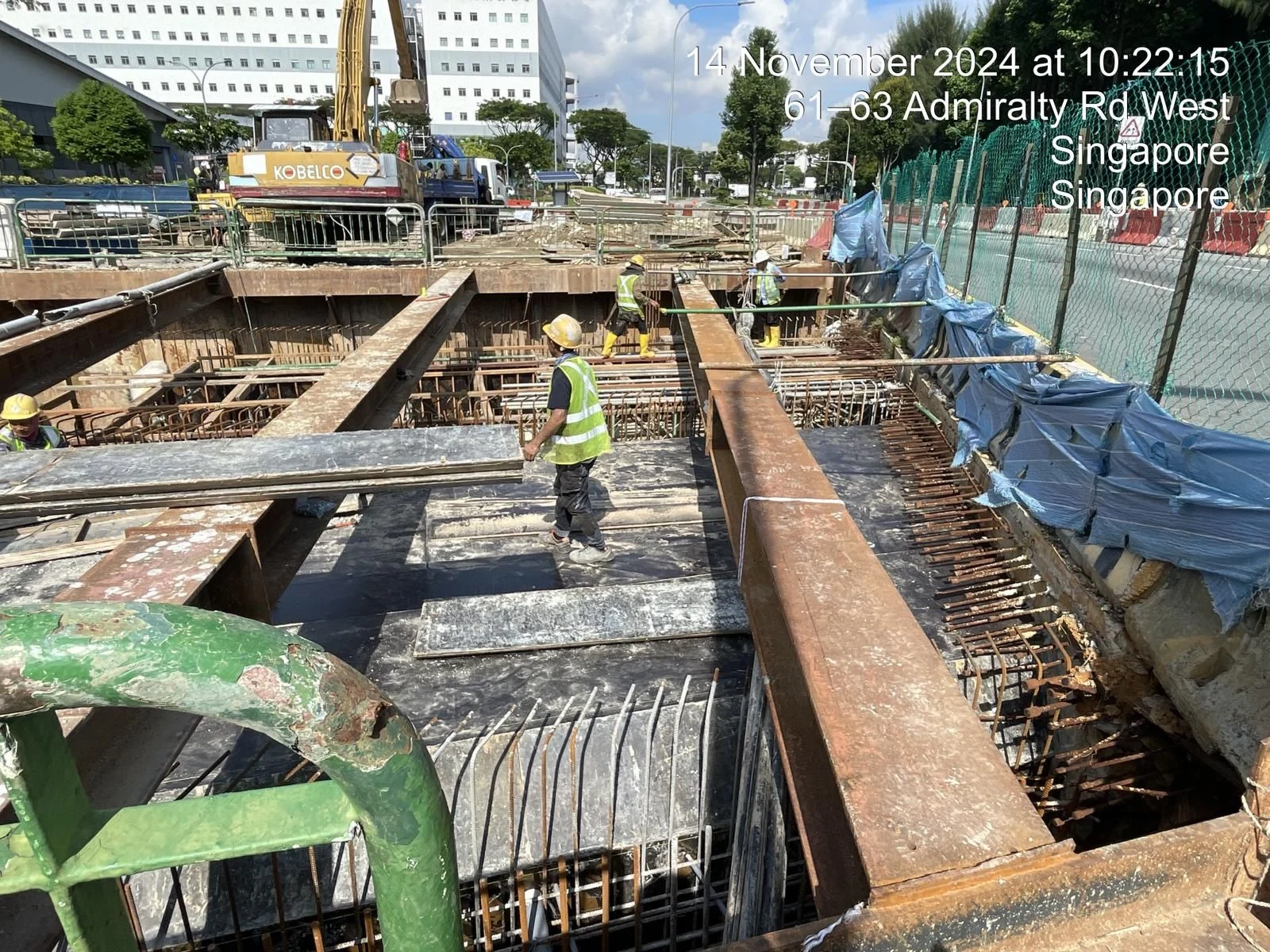
Trial trenches and probing identified existing services before excavation. These included old British Army fuel pipes at the surface, Singtel cables, 66 kV, high-tension and low-voltage cables, and 300 mm and 1,800 mm water mains. Underground services were found at depths of 1–5 metres. Temporary steel supports, designed by the project’s professional engineer, protected them throughout construction.
Deep excavation
Deep excavation had to proceed around the live services. Earth retaining and stabilising structures (ERSS) were installed in sections to retain the surrounding soil while the services remained supported. This required careful sequencing and additional protection work.
Tidal water management
Two automated tidal gates controlled seawater entering the outlet drain. Water-level sensors activated the gates, helping the team manage tidal flow and rainwater during construction and maintain suitable working conditions for longer periods.
Using natural energy for site power supply
Solar panels replaced some diesel-generated power on site. They supplied the CCTV system, temporary bus stop and automated tidal gates, reducing reliance on diesel while lowering operating costs.
Traffic diversion
Hocklim revised the proposed traffic diversion from six phases to two. This reduced disruption and improved continuity of the works. The project combined deep excavation, live utility protection, tidal water management and traffic coordination.