
The Challenge
Heavy rainfall caused flash floods at the junction of Craig Road and Tanjong Pagar Road. Water entered nearby food and beverage outlets and disrupted road traffic.
The Solution
Hocklim and PUB surveyed the drainage network and identified a bottleneck at the junction. The project focused on improving that connection.
Runoff from Craig Road met another drainage flow along Tanjong Pagar Road. The intersecting flows restricted discharge to the drain across the road, allowing water to accumulate faster than it could drain away.
Hocklim installed steel pipes across Tanjong Pagar Road to connect the Craig Road and Tanjong Pagar Road drains separately to the receiving drain. This made better use of the available downstream capacity.
Trial trenches were required to locate existing cables and water pipes before selecting routes for the new steel pipes.
Work proceeded one lane at a time, with traffic management measures in place to maintain access.
Trial trenches along Tanjong Pagar Road
A diamond cutter opened the road surface before manual excavation of the trial trenches.
The team excavated manually to a depth of 1 metre to avoid damaging services. Where cables were found, the trench was backfilled, compacted and reinstated with premix matching the existing thickness. The process continued at other locations until suitable routes were identified.
Two locations free of cables and water pipes were identified. With PUB’s approval, Hocklim proceeded with the pipe installation.
Excavation reached 1.6 metres. Bakau piles were installed to a depth of 3,000 mm at 300 mm spacing, followed by a 200 mm hardcore base and 50 mm of G15 lean concrete. Two layers of B10 mesh reinforced a 100 mm G35 concrete slab.
Installation of Steel Pipes
After the base cured, six steel pipes measuring 8 m × 114.3 mm × 8.56 mm were laid near Tras Link. Eight pipes measuring 8 m × 141.3 mm × 9.52 mm were installed near Craig Road. A further two layers of B10 mesh and a 100 mm G35 concrete slab were placed above the pipes.
Tack coat was applied to the cured concrete before premix reinstatement. This bonded the asphalt and concrete layers and reduced the risk of slippage between them.
Auxiliary Police officers assisted with traffic control at the junction in accordance with LTA road closure requirements.
Lane-by-lane closures allowed excavation to proceed while maintaining traffic flow.
Measure taken to ensure traffic is not affected
Figure 18: Temporary steel plates and premix covering the trenches for traffic
Where a trench could not be reinstated that day, or the road needed to reopen urgently, 25 mm steel plates covered it. The plates carried 50 mm of W3B premix to meet LTA skid-resistance requirements.
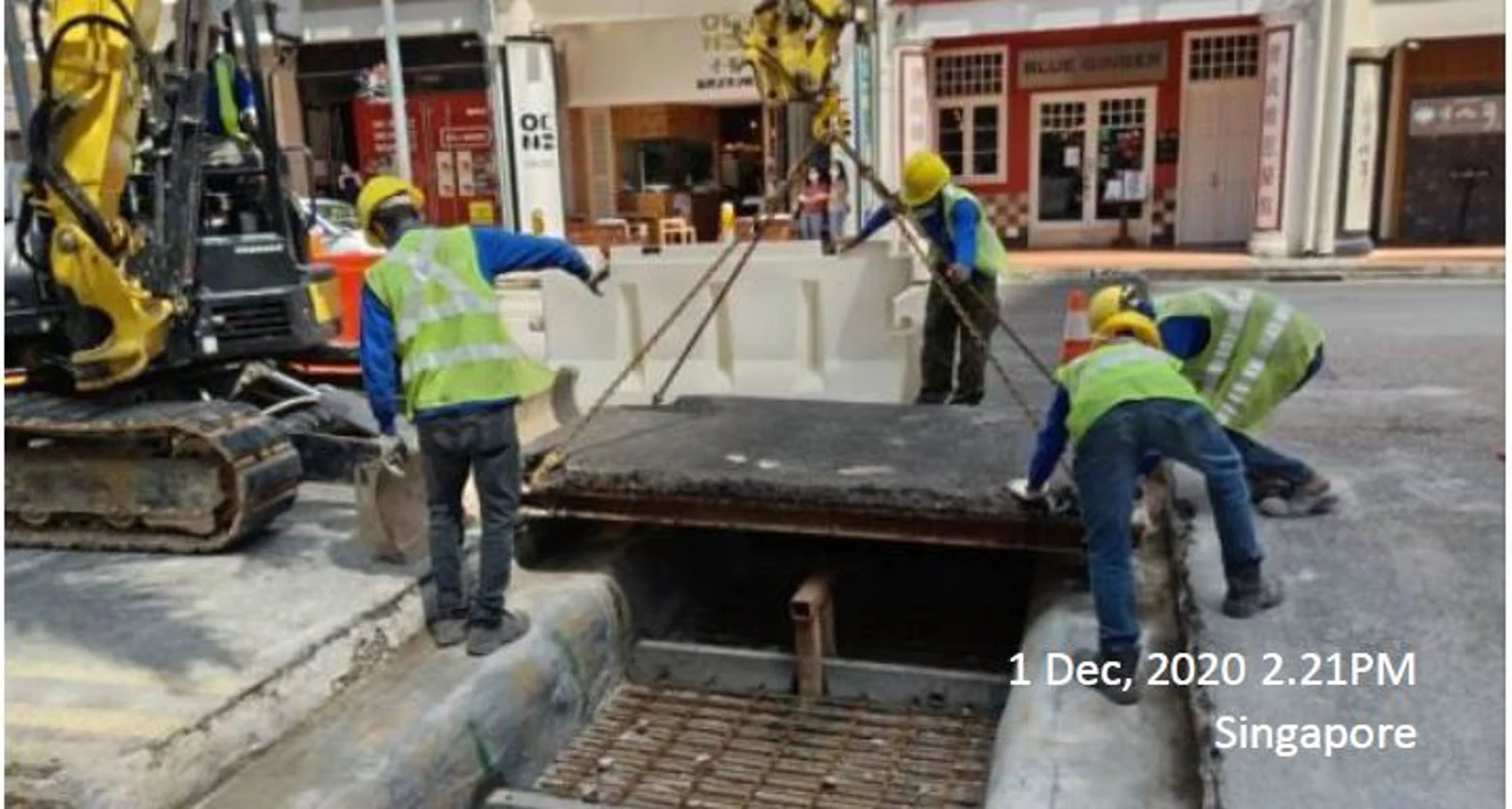
The team opened the pavement in front of the shophouses to connect the existing drains to the new steel pipes. A Type 3 drain was also constructed along Craig Road to improve runoff collection.
Steel Pipe connection to existing drainage - Junction of Craig Rd & Tanjong PagarRd
The pavement was retiled after the concrete works. Type 3 gratings along Craig Road improved water entry into the drainage system.
The separate steel pipe connections removed the bottleneck created by the intersecting drains. Together with the new drain and gratings, they improved discharge towards the receiving drain across Tanjong Pagar Road.