
The Challenge
Prolonged monsoon rainfall could push drains and canals around Tan Kah Kee above 90% of their capacity. Flash floods left vehicles in wheel-high water and disrupted traffic.
The Solution
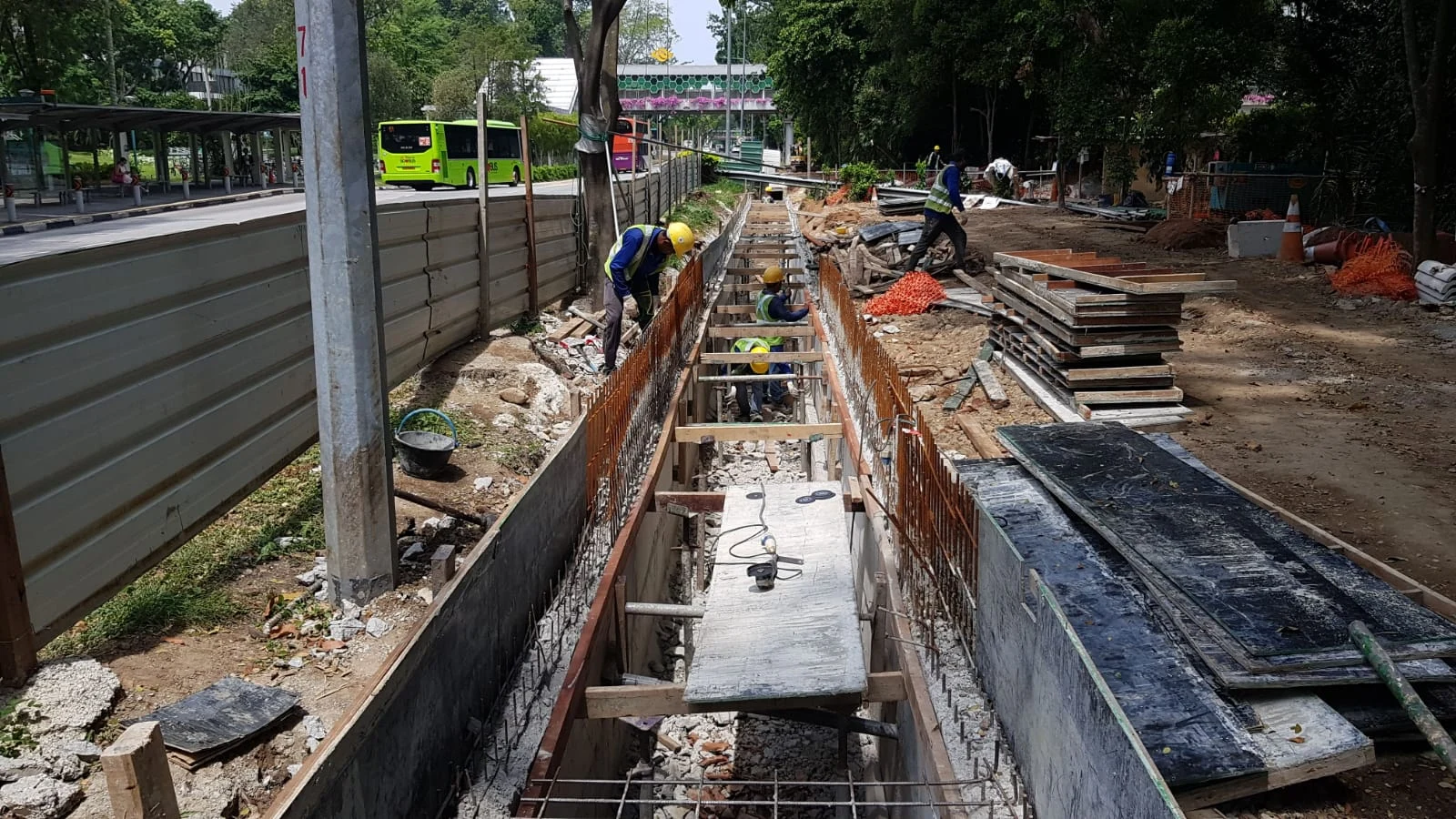
Hocklim designed a box drain connected to an existing open drain leading to Bukit Timah Canal. It improved the flow of surface runoff and provided temporary water storage during heavy rainfall.
Before excavation, Hocklim coordinated vegetation clearance and preservation with NParks. A certified arborist carried out visual tree assessments to identify trees for preservation, transplantation or removal.
Box drain - Detention Drain along Drainage reserve
Trial trenches were excavated manually to locate cables. Hydraulic excavators then worked to a depth of approximately 0.5 metres, with a further 1 metre excavated using manual tools to protect existing services. A cable detection specialist assessed exposed cables, which were protected immediately. Shoring supported the excavation beside the road.
The box drain was less than 100 mm from an 800 mm water main. Hocklim prepared a risk assessment and an instrumentation and monitoring plan to manage the risk of damage. An instrumentation engineer checked and recorded vibration levels against the allowable limits.
Precast U-drain sections were manufactured while excavation continued. This parallel sequence helped meet the project’s urgent programme and allowed installation to proceed efficiently.
After the U-drains were lifted into position, the walls were extended and a top slab was cast to form the box drain. The completed works added 425.12 m³ of drainage capacity.
Stoplogs were installed at the drain’s entry and discharge points so that it could operate as a detention tank during heavy rainfall.
Stoplog System - Remote activated
Hocklim designed and installed a stoplog system to manage water flow. Each stainless steel panel controls a drainage opening.
A steel wire cable connects each panel to a motorised winch that can be operated remotely through a website. A manual hand crank provides a backup.
CCTV provides a live view of flood conditions. When water in the main canal rises too high, a remote I/O controller activates the stoplog at the discharge point to prevent backflow. Closing the stoplogs retains water within the box drain.
How it works
When it rains, rainwater will drain into Drainage A and flow into Bukit Timah Canal
Rainwater first enters Drainage A and flows towards Bukit Timah Canal. At the activation level, Stoplog A is lowered to close that outlet. As Drainage A fills, water overflows into Drainages B and C, which provide temporary storage.
When the canal’s water level falls, Stoplog A is raised to release the stored water. The pressure difference increases the discharge flow and frees capacity in Drainage A. The cycle can be repeated to manage water levels.
After the rain subsides, Stoplogs A, B and C are raised to empty the drains. Stoplogs B and C are then lowered, while Stoplog A remains open in its default position.
The design was developed in collaboration with Mr Tan Hooi Soon of PUB. The added 425.12 m³ of capacity and controlled stoplog system work together to improve flood management around Tan Kah Kee.
Remote operation and live CCTV allow the system to respond with limited on-site manpower.
Figure 13: Stoplog A in operation