The Challenge
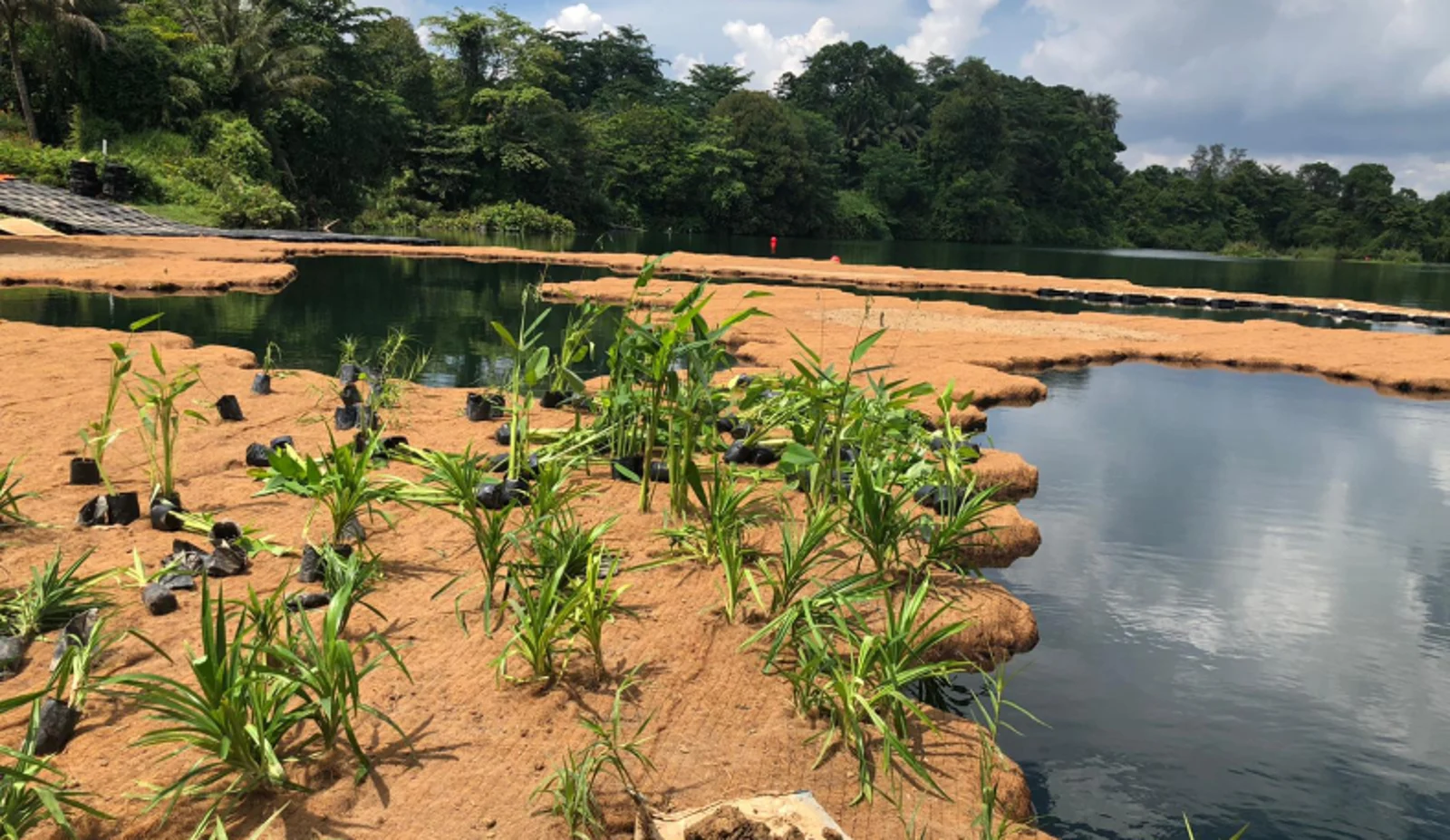
Pekan Quarry, formerly Ho Man Choo Quarry, is one of Pulau Ubin’s oldest quarries. It has developed into a freshwater habitat supporting a range of plants and animals. NParks introduced floating wetlands in 2015 through a pilot habitat enhancement initiative. Following its success, the project expanded the area available for wildlife.
Benefits of Freshwater Wetlands
Wetlands help filter sediment and pollutants from the water. Their planting also provides food and nesting habitat for birds, mammals and insects.
Building of Floating Wetlands
Hocklim worked with ISO-Landscape Pte Ltd and Professor Ang Kok Keng of NUS to design and build the floating system. Hexagonal modules developed by HDB were made from high-density polyethylene (HDPE) and filled with polyurethane foam. Each module supports loads of up to 80 kg. Joined together, they form platforms shaped to resemble natural islands.
More than 6,000 modules formed three wetland clusters and one nesting platform, covering over 4,000 m². The platforms support 15,000 plants from 13 native species. Linkages and a customised anchorage system connect and secure the islands. NUS carried out detailed design analysis for the site’s environmental conditions.
Design Checks
Hydrostatic equilibrium and stability checks covered all three clusters and the nesting platform. Load estimates included the modules, soil and plants. The design study established a soil thickness that could support the intended vegetation.
Plant loads were calculated from the planting plan, covering groundcover, flowering shrubs, medium shrubs and tall shrubs. Module, soil and plant weights informed the loads on each island and cluster. Buoyancy checks based on Archimedes’ principle confirmed the required capacity. Hydrodynamic analysis assessed wind, wave and current loading.
The analysis found minimal wave-induced movement across the clusters, with acceptable hydrodynamic performance.
Mooring system
Mooring lines at four tethering points hold the clusters in position. Stainless steel brackets, plates, bars and eyebolts connect the islands to the lines. The design accounted for mooring-line stiffness and its effect on load distribution and island movement.
Hocklim designed and built a floating crane, secured to the modules for stability, with an electric winch to deploy the sinkers. Trial tests checked the winch and steel structure. Each sinker comprised 2 tonnes of granite in a geosynthetic bag; 26 bags were prepared. GPS coordinates and marker buoys identified the deployment locations.
The electric winch lowered the sinkers to the quarry bed at the marked locations.
Once the sinkers were deployed, the islands were positioned and connected to their mooring brackets. The anchoring ropes were tensioned, floating mats were installed around the edges and geotextile was laid over the modules before adding topsoil.
Plants and shrubs were installed according to the planting plan. Work progressed one cluster at a time: design checks, assembly and planting were completed before moving to the next cluster.
Heron Nesting Platform
A separate floating platform supports nesting structures designed to resemble natural heron nesting sites. It also provides habitat for other birds. Unlike the planted clusters, this platform primarily carries tree-like posts and nesting areas.
Finite element modelling informed the aluminium and steel structure. Each powder-coated aluminium circular hollow section (CHS) post resembles a tree. Stainless steel CHS and angle braces hold it in position, with C-channel members bolted to the HDPE modules. Each post carries up to four nesting platforms, depending on its length.
The nesting platforms use modular aluminium angle members and bracing, attached to the posts with bolted connections. Extensions provide perching space. Design checks considered the weight of the posts, nests and birds, together with environmental loads.
Analysis confirmed the adequacy of the proposed structural members and connections. The base frames connect directly to C-channel sections on the floating platform.
Following approval, Hocklim manufactured ten nesting structures. Chengal wood cladding covered the aluminium platforms, with rounded corners for resting birds. Two information signs were installed after completion of the three clusters and nesting platform. Completed in 2021, the project expanded habitat and supported biodiversity at Pekan Quarry.
The project received NParks’ Landscape Excellence Assessment Framework (LEAF) Silver certification with a Special Mention for Conservation and Biodiversity. It also received a 2021 Honor Award from the American Academy of Environmental Engineers and Scientists. The completed wetlands have attracted visitors interested in Pulau Ubin’s birdlife and freshwater habitat.